Look at a ski photo from 1958 and you'll see something that looks oddly modern: slim stretch pants, a short clean jacket, a silhouette that follows the body like a wetsuit. Back then, looking "fast" meant dressing tight. The message was simple — the sleeker the line, the more serious the skier.
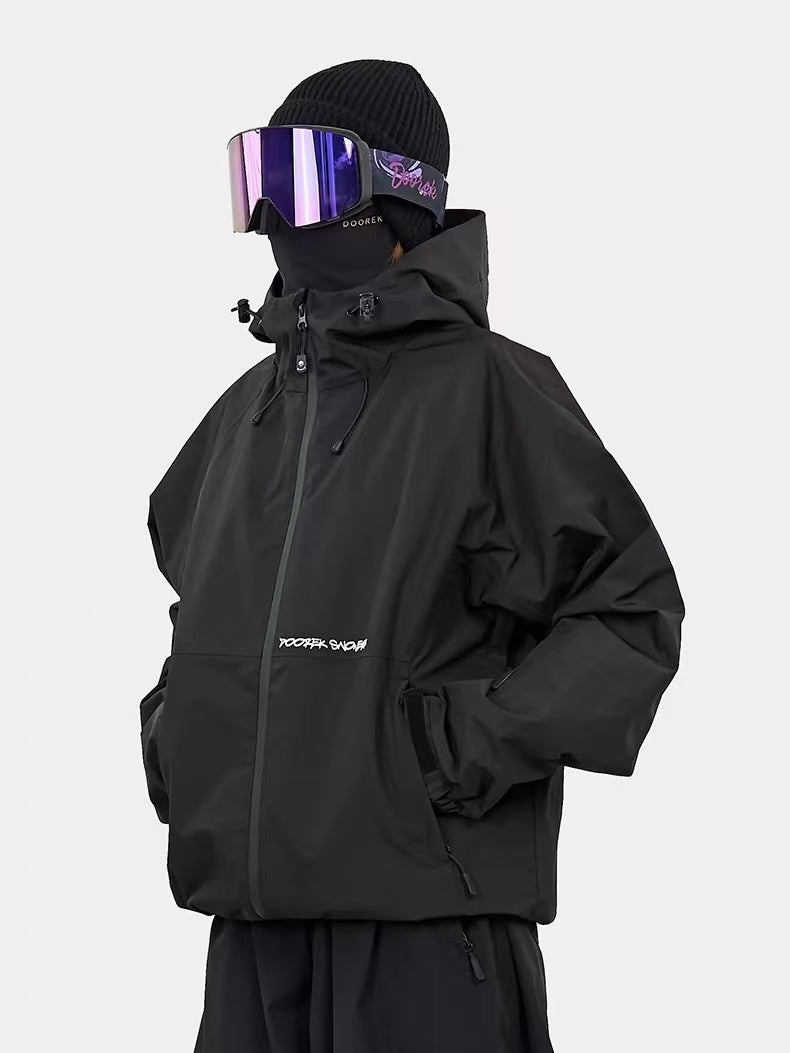
Now stand in the lift line at Park City, Breckenridge, Mammoth, or Whistler on a pow day. The young riders are wearing something else entirely. Jackets that swallow their torsos. Pants with enough fabric to pool over their boots. Bibs that read as a choice, not a necessity.
So here's the direct answer to the question on this page: ski clothes are getting baggy again for four reasons that have nothing to do with each other — stretch-fabric history, snowboard culture, freestyle skiing, and modern layering — plus a fashion swing back toward oversized silhouettes. And here's the twist that most people miss: ski clothes started out baggy. The pendulum has been swinging for over a century.

Chapter 1 — Ski clothes were never slim to begin with
Before stretch fabric existed, skiers faced a hard physics problem: clothes don't stretch.
In the late 1800s and early 1900s, skiing borrowed its wardrobe from general winter outdoors wear — wool trousers, wool sweaters, heavy coats, anoraks. These materials kept you warm and blocked some wind, but they had almost zero elasticity. When a skier bent a knee, dropped into a tuck, or fell, the only way to get room to move was to build it into the pattern: make the pants wider.

Early baggy ski trousers weren't a fashion statement. They were the original articulation — extra fabric functioning as a hinge joint before any designer had a word for it.
Today a good pair of ski pants buys you mobility a dozen ways: mechanical stretch, four-way stretch fabric, articulated knees, a crotch gusset, pre-bent leg shaping, an elastic waist, and patterns shaped around a bent-leg stance. Mid-century skiers had none of that. Their only lever was volume.
That's why, in those early photos, the hips, thighs, and knees of ski trousers look noticeably roomier than the race-ready pants of the 1950s and 60s. The first baggy fit was a workaround for a technical limit.

Chapter 2 — One woman's stretch pants flipped the whole script (1952)
The turn from loose to tight happened fast, and one name sits at the center of it: Maria Bogner.
Before the breakthrough, Bogner was already making ski trousers from gabardine — a tightly woven, hard-wearing fabric that shrugged off wind and light snow. Its flaw: it didn't stretch, and at speed, loose pant legs flapped in the wind. For a racer chasing hundredths, that flapping fabric was dead weight and drag.
Around 1952, Bogner began making ski pants with Helanca, an elastic nylon yarn that could be knit or blended with wool. It sounds like a small materials tweak. It was actually a redesign of the entire logic of ski clothing:
- Before: mobility = wider pants.
- After: mobility = the fabric itself stretches.
Those two logics produce opposite silhouettes. Bogner's stretch pants hugged the leg and moved with it — the first ski garment that could be both tight and functional. (She also gets credit for popularizing the powder skirt around the same era — the same pattern of "solve a real problem, accidentally define a look.")

Chapter 3 — Why slim took over (and why it looked so good)
Stretch pants won for three reasons, and they stacked on top of each other.
1. It was faster. For racers, a clean, continuous outer surface meant less air resistance. No flapping, no ballooning, no gaps. Racing embraced the new cut immediately.
2. It looked modern. The 1950s and 60s were when skiing became a lifestyle, not just a sport. Aspen, St. Moritz, and Cortina d'Ampezzo turned resorts into social stages. Ski clothes became both equipment and fashion, and the stretch pant's clean line fit the era's obsession with body-conscious elegance.
3. Tech and fashion finally agreed. For the first time, a genuine performance advantage — elasticity — translated directly into a new aesthetic. From then on, for decades, "technical" and "slim" were treated as the same thing. The tighter the cut, the more serious the skier.

By the 1960s, the classic Alpine look was locked in: fitted stretch pants, a short structured jacket, a clean waistline. Flip through resort photos from that decade and you might find them more tailored than what most skiers wear today.


Chapter 4 — Snowboarding tore up the rulebook (1980s–90s)
What eventually killed the slim orthodoxy wasn't a new fabric. It was a new sport with a different cultural bloodline.
Through the 1980s and into the 90s, snowboarding moved from fringe to mainstream resort culture. But early snowboarders had no interest in becoming "skiers on one plank." Snowboarding grew out of skateboarding, surfing, punk, hip-hop, and streetwear — subcultures where baggy wasn't a mistake, it was a uniform.
Traditional alpine skiing prized clean, slim, mature, precise. Early snowboard culture prized loose, young, free, defiant. The baggy snowboard fit was never just a wide pant leg. It was an identity marker: I am not dressing by your rules.
By the mid-90s, you could often guess someone's tribe from the lift line. Skiers in fitted pants and structured jackets. Snowboarders in boxy jackets, oversized pants, and hoodies under their outerwear. That divide wasn't random — it was the skate culture language being spoken at altitude.

Chapter 5 — Freeskiing carried baggy back across the aisle (late 90s–2000s)
If the story had stopped there, baggy might have stayed a snowboard-specific aesthetic. But skiing itself changed.
In the late 1990s and 2000s, freestyle skiing exploded: terrain parks, rails, halfpipes, and twin-tip skis created a new kind of skier who shared the park, the hits, the music, and the style with snowboarders. Twin-tips are the cleanest example — a ski designed to ride and land switch — but the clothing followed the same arc. When your body is compressing for a takeoff, spinning, grabbing, riding switch, and absorbing landings, a fitted alpine shell isn't the obvious tool anymore.
Early-2000s freeski style went gloriously overboard: enormous jackets, absurdly wide pants, long t-shirts hanging out the back. It looks dated now. But it did the important work: baggy officially moved from snowboarding into skiing.
Chapter 6 — Baggy isn't just culture. It does stuff.
If baggy ski wear had no function, it would have died with the last fashion cycle. It didn't — because in freestyle and freeride, a roomier cut genuinely performs.
More room where the body actually moves
Skiing isn't a static pose. Freestyle and freeride riders compress hard before takeoffs, squat to absorb landings, reach across their body for grabs, and twist through rotations. Modern relaxed and baggy fits add space where it matters — shoulders, hips, thighs, and knees — not everywhere.
That distinction matters: real baggy ski wear isn't just a normal garment scaled up. Designers still build in articulated knees, pre-shaped sleeves, crotch gussets, stretch panels, and adjustable hems and cuffs. The goal isn't "as much fabric as possible." It's usable space where the movement happens.
The layering system changed the shell's job
Here's what most people overlook: old ski clothes were one thick garment. Modern technical outerwear is a system — base layer for moisture, midlayer for warmth, shell for wind, snow, and water. A slim shell fits fine over a single base layer. At 5°F, when you want fleece plus a puffy midlayer underneath, you run out of room fast.
Worse: an overly tight shell compresses your insulation. Down and high-loft synthetic fills trap warmth in dead air — squash them and you lose the loft that does the work. That's a big part of why all-mountain and freeride shells today ship with built-in room. It's not to make you look big. It's so the same jacket works thin on warm days and layered on cold ones.
Modern fabric broke the old "baggy = heavy" equation
Forty years ago, a big jacket meant thick, heavy, and slow-when-wet. Today's 3-layer construction — a face fabric, a waterproof-breathable membrane, and an inner backer bonded into one thin system — delivers serious weather protection at a fraction of the old weight. Since membrane technology went mainstream in the 1970s, designers stopped needing bulk to buy protection.
The result: you can now buy a genuinely wide 3L shell pant with no insulation, or an oversized shell jacket that's lighter than the old insulated jackets. Modern baggy didn't return to the past — it reused the silhouette with completely different technology underneath.
Chapter 7 — Bibs, freeride, and the street all pushed it wider
Why bib pants came back
The baggy revival overlaps almost exactly with the bib pants revival. Waist pants have a built-in weakness: a gap at the beltline where powder sneaks in on every fall. Bibs extend coverage up to the chest, which matters in deep snow, in the trees, and in the park. And bibs are a natural home for a loose cut — with suspenders holding position instead of a waistband, the hips and thighs can run roomier while the fit stays put. Baggy + bib + freeride has become one of the most recognizable looks on the mountain for a reason.
Freeride wants relaxed, not uncontrolled
Freeride skiers live in powder, trees, steep terrain, and variable snow. Their bodies change position constantly, and the deeper the snow, the bigger the movement range. But modern freeride baggy is usually structured baggy — wide, with shape — not the exaggerated early-2000s park look. "Wide, but engineered" beats "wide for its own sake."

Streetwear caught up, again
Off the mountain, fashion spent the 2010s in a slim-fit phase — skinny jeans, tailored everything — and ski wear followed. Enter the 2020s, and the pendulum swung back: wide-leg pants, boxy tops, relaxed denim, oversized outerwear are mainstream again. The baggy look that snowboarding and freeski never abandoned suddenly synced with what people were already wearing in the city.
That's the key difference from the 2000s. Then, baggy was subculture. Today it exists at the intersection of subculture, performance wear, and mainstream fashion — which is why it ended up in regular resort skiers' closets, and why ski jackets are now designed to look good in a lodge, on a plane, and on a street corner, not just on the chairlift.
Which fit should you actually ride?

Baggy isn't objectively better than slim — it's better for some ways of skiing. Here's the honest map:
| Fit | Best for | What it gives you | Watch out |
|---|---|---|---|
| Slim / Race fit | Racing, high-speed carving | Streamlined, low drag | Little room to layer |
| Regular fit | Everyday resort skiing | Balanced, easy to drive | Can read as dated |
| Relaxed fit | All-mountain, freeride | Movement room + control balance | Check real sizing |
| Baggy / Oversized | Freestyle, snowboard, freeride | Big movement range, layering, look | Overdone sizing hurts control |
So "ski clothes are getting bigger" needs a qualifier: not everything is. Race suits stay skin-tight — racing still chases drag. And touring gear isn't chasing baggy either; every extra gram and cubic inch costs you on the skin track, which is why touring shells lean lean. The silhouette still follows the riding style.
Baggy myths, busted
1. "I'll just size up two sizes"
The single most common mistake. A purpose-built baggy jacket has redesigned proportions: shoulders that are loose without dropping the sleeves, longer and wider sleeves that still land right when you bend your arm, a longer hem that doesn't limit your legs, a hood sized around a helmet, and pockets repositioned for the longer body. Baggy ski pants add volume through the hips, thighs, and knees while keeping the waist stable and the cuffs compatible with your boots — often with snaps, zips, or drawcords to manage the excess. Baggy is pattern design, not a size-up. That sentence is the whole lesson.
2. "Baggy means warmer"
Not automatically. Warmth comes from insulation, layering, wind protection, and moisture management. The real advantage of a roomy shell is that you can add midlayers underneath — a fleece on cold days, a synthetic puffy when it's brutal. That adjustability is the warmth benefit. An uninsulated oversized shell alone is not warm just because it's big.
3. "Baggy means colder"
Also not necessarily. A well-designed oversized jacket seals the same openings — adjustable hem, powder skirt, wrist gaiters, adjustable cuffs, high collar, hood cinches. The design principle in modern snow wear is simple: the body can be loose, but the openings stay controlled. That's exactly why drawcords and cuffs matter more on a baggy jacket, not less.
4. "Beginners shouldn't touch baggy"
Beginners can absolutely ride relaxed fits — easier knee bend, no fabric fighting you in a fall, and room to grow into layering. The caveats are practical: sleeves shouldn't swallow your hands at rest, pant cuffs shouldn't drag underfoot, the waist has to stay put (especially without bib straps), and the hood still has to cinch over a helmet. The right baggy fit feels like more room, not like swimming in fabric.
The pendulum keeps swinging — and now you know why

Lay the last hundred years of ski wear end to end and it's not a straight line — it's a pendulum:
- 1900s–40s: wool, no stretch → clothes have to be wide.
- 1950s: Maria Bogner's Helanca stretch pants → slim is suddenly functional.
- 1960s: alpine racing and resort glamour push slim to its peak.
- 1980s–90s: snowboarding imports skate and street culture → baggy returns.
- Late 90s–2000s: freestyle skiing adopts the language → baggy goes mainstream in skiing too.
- 2010s: skinny-jeans era pulls performance wear back toward slim.
- 2020s: freeride, streetwear, Gorpcore, and modern shell tech push it wide again.
So when you see a genuinely wide ski pant or a jacket that covers your butt, what you're actually looking at is a stack of history: wool trousers with no stretch, Maria Bogner's gamble on Helanca, alpine racing's obsession with drag, 90s snowboarders' refusal to dress by alpine rules, the rise of the terrain park, and today's lightweight 3-layer shells.
Here's the cleanest way to put it: a hundred years ago, ski clothes were baggy because technology couldn't do better. Today they're baggy because technology is good enough that designers can choose. Back then, baggy was a limitation. Now it's a decision. That's the most interesting thing about a hundred years of ski fashion — and why baggy ski wear deserves to be understood, not just written off as a trend.
What We Wear — why we dress like this
This is part of The Evolution of Skiing, a series that doesn't just explain what a piece of gear does — it asks why it became what it is today. Why did ski pants go from baggy to skin-tight and back? Why does your jacket have a powder skirt? Why did bibs disappear and then come roaring back? Why are modern shells thinner but tougher than anything before them?
Every change in ski gear traces back to a change in how people ski. That's the story we're telling.
Frequently asked questions
Why are ski clothes getting baggy again?
Because four separate forces converged: stretch fabrics ended the old "slim equals functional" logic, snowboard and freestyle culture normalized baggy fits in skiing, modern layering systems need roomy shells to function, and 2020s streetwear swung back toward oversized silhouettes.
Are baggy ski clothes warmer?
Only indirectly. A roomy shell lets you add midlayers underneath, which gives you a more adjustable system. But an uninsulated oversized shell is not automatically warm — warmth comes from insulation, layering, and sealing out wind and moisture.
Is baggy ski wear just a trend?
No. It's a recurring cycle with real function behind it. Baggy fits genuinely help in freestyle, snowboarding, and freeride, where riders need large ranges of motion — and the current cycle is reinforced by streetwear and Gorpcore, which made the look mainstream again.
Do I need to size up for baggy ski clothes?
No. True baggy ski wear is cut baggy from the pattern — shoulders, sleeves, hem, hood, and pockets are all redesigned. Buying two sizes up from a regular jacket usually gives you the wrong proportions: sleeves too long, hood too loose, and a hem that interferes with movement.
Can beginners wear baggy ski clothes?
Yes, as long as the fit stays practical: sleeves that don't cover your hands, cuffs that don't drag, a waist that stays put, and a hood that cinches over a helmet. Relaxed fits are often easier for beginners because there's no fabric restricting movement.
Are baggy ski jackets good for freeride?
Generally yes. Freeride riders move a lot — powder, trees, steeps, variable snow — and relaxed fits give them room to layer and move. Most freeride-specific jackets are cut relaxed-but-structured rather than extreme oversized.
Keep reading
- Best Baggy Ski Jackets 2025–2026: The Only Buying Guide You Need
- Best Baggy Ski Jackets 2025–2026: Do You Actually Need Gore-Tex?
- Why Gore-Tex Isn't Your Only Option for Snow Gear
- Best Ski Jackets & Pants of 2026 – Top-Rated Picks for Every Rider
Disclaimer: This article is part of an editorial series on the history and design of ski equipment. Product links are provided for convenience; the recommendations reflect editorial judgment, not sponsorship.