Walk into any ski shop or scroll through gear forums and you'll hear the same thing: "Just get Gore-Tex." The implication is clear — anything else is a compromise. But when the price gap between a Gore-Tex shell and a well-built proprietary membrane jacket runs to $200, $300, even more, it's worth asking: what are you actually paying for?
This guide compares five of the best baggy ski jackets for 2025–2026 across a range from $189 to $500. We'll break down the fabric technology honestly, tell you when Gore-Tex genuinely earns its premium, and when you're mostly paying for a logo on the tag.
The Gore-Tex Question: What You're Actually Paying For
Gore-Tex is genuinely excellent. Its ePTFE membrane delivers waterproofing north of 28,000mm and breathability that improves under pressure — meaning the harder you work, the better it vents. In truly extreme conditions (multi-day backcountry touring, sustained heavy wet snow, Pacific Northwest coastal storms), that performance difference is real and meaningful.
But here's the part the marketing doesn't tell you: most resort skiers never push their jackets anywhere near those limits.
A typical resort day involves chairlift rides, groomed runs, and maybe some powder on a good day. Conditions are cold and dry, not sustained wet and stormy. In that environment, a well-constructed 15K–20K proprietary membrane — like 686's infiDRY, The North Face's DryVent Mono, or Doorek's 3-layer construction — performs identically to Gore-Tex for the overwhelming majority of riders.
The Gore-Tex premium buys you two things: long-term durability under extreme use, and peace of mind. If you're a serious backcountry rider, a ski guide, or you're out in heavy wet conditions daily, that's worth every cent. If you're hitting the resort 10–20 days a season, you're paying a significant premium for performance headroom you'll never use.
What Actually Matters More: 2L vs 3L
Here's the spec that matters more than the brand name on the membrane: how many layers the fabric has.
- 2-layer (2L): Outer fabric + bonded membrane, with a separate hanging liner inside. Heavier, more packable, softer feel. Most budget and mid-range jackets.
- 3-layer (3L): Outer fabric + membrane + bonded inner backer, all laminated together. Lighter, more durable, breathes more directly, feels more technical. Premium construction — but doesn't require Gore-Tex to do it right.
A 3L proprietary membrane jacket will outperform a 2L Gore-Tex jacket in most real-world conditions. Keep that in mind when you're reading specs.
The 5 Best Baggy Ski Jackets for 2025–2026
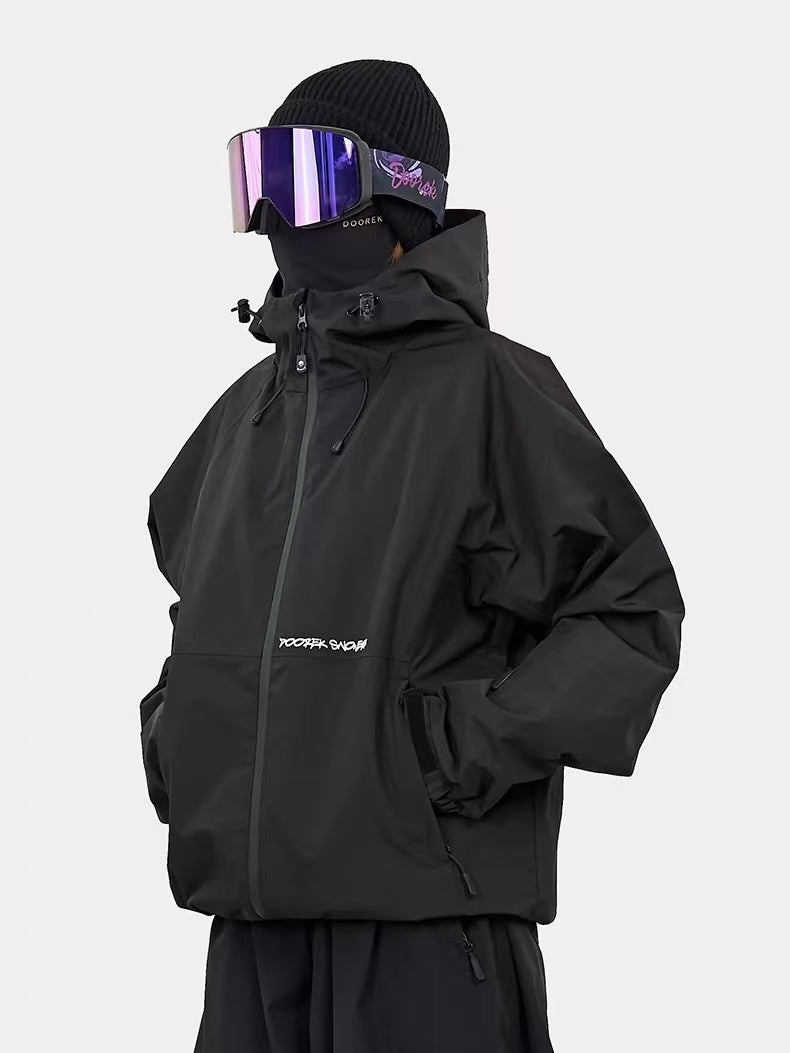
1. Doorek 3L Baggy Realm Down Ski Jacket — Best Overall

| Price | $189 |
| Construction | 3-layer proprietary membrane |
| Insulation | Down-filled |
| Fit | True baggy, unisex |
| Best for | Resort skiers, park riders, gift buyers, value seekers |
This is the one jacket in this comparison that pulls off something none of the others manage at anywhere near the price: 3-layer construction combined with real down insulation, for $189.
Most jackets at this price point use 2L construction and synthetic fill. Most 3L jackets cost $350+. Most down-insulated technical jackets cost $400+. The Baggy Realm Down combines all three — 3L shell, down warmth, genuinely baggy freeride fit — at a price that undercuts the competition by $100 to $300.
The trade-off is honest: the proprietary membrane won't outlast Gore-Tex under years of hardcore backcountry abuse. But for resort use — which is 95% of who's reading this — the real-world performance gap is negligible. You stay dry, you stay warm, you have full range of motion. What more do you need?
What we like: Unmatched value for the spec sheet. True baggy fit that works for park laps and powder days. Down warmth means you can get away with a lighter base layer. Available in multiple colorways.
What to know: Not built for extreme backcountry use or sustained heavy wet conditions. Size up if you're between sizes — the baggy cut runs true but the shoulders fit snugly.
→ Shop the Doorek 3L Baggy Realm Down — $189

2. Burton AK Swash GORE-TEX 2L Jacket — Best for Serious Riders
| Price | $500 |
| Construction | GORE-TEX 2L |
| Insulation | PrimaLoft® core insulation only |
| Fit | Slightly relaxed, not full baggy |
| Best for | Frequent riders, variable weather, all-mountain use |
This is the one jacket in this roundup where we'll say it plainly: the Gore-Tex is actually worth it. The AK Swash is Burton's rider-focused line — designed for people who are on the mountain constantly, in all conditions, all season. The GORE-TEX 2L construction delivers waterproofing and breathability that holds up over hundreds of days of use in a way that proprietary membranes typically don't match long-term.
The design is smart: PrimaLoft insulation is focused on the core only, leaving the arms uninsulated for freedom of movement. You layer underneath, and the jacket handles the weather. It's a more technical, versatile approach than a fully insulated jacket — better for riders who run hot or ski across a wide range of temperatures.
The fit is slightly relaxed rather than full baggy — it has room, but it's not the oversized park-style silhouette of the Doorek. If you want maximum bagginess, this isn't it. If you want maximum performance from a jacket you'll wear hard for five seasons, this is the one.
What we like: GORE-TEX reliability for serious use. Intelligent insulation placement. Excellent feature set (pit zips, powder skirt, pass pocket, internal pockets). Built to last.
What to know: $311 more than the Doorek for performance that resort skiers won't fully use. Not a true baggy fit. You'll need a proper mid-layer for cold days.
3. The North Face Dragline DryVent Mono 3L — Best Brand, Questionable Value
| Price | $450 |
| Construction | DryVent™ Mono 3L (proprietary, not Gore-Tex) |
| Insulation | None — shell only |
| Fit | Freeride / relaxed baggy |
| Best for | Style-conscious riders who want a recognizable brand |
Let's be direct about something: the Dragline is not a Gore-Tex jacket. At $450, many shoppers assume it is — but TNF uses their own DryVent Mono membrane, a mono-material proprietary construction that sits comfortably in the 15,000mm waterproof range. It performs well. It's a solid jacket. But you're not paying $450 for technical superiority — you're paying for the North Face logo, the bold colorways, and the cultural cachet that comes with it.
That's not a criticism — brand identity has value, and the Dragline genuinely looks great on the mountain. GearJunkie testers noted it attracted more unsolicited compliments than any other jacket tested this season. If that matters to you, it matters. Just go in clear-eyed: at $450 with a proprietary shell and no insulation, the pure performance-per-dollar math doesn't add up compared to the alternatives here.
What we like: Excellent color options and aesthetic. 3L construction despite the proprietary membrane. Recognizable brand for those who care. Good feature set.
What to know: Not Gore-Tex despite the price. Shell only — you're layering underneath in cold weather. $261 more than the Doorek for comparable real-world waterproofing.
4. 686 Hydra Insulated infiDRY 20K — Best Mid-Range
| Price | $300 |
| Construction | infiDRY 20K (2L) |
| Insulation | Synthetic — body mapped (80g body / 60g arms / 40g hood) |
| Fit | Relaxed baggy |
| Best for | Riders who want strong waterproofing without Gore-Tex pricing |
686's infiDRY 20K is one of the clearest examples that you don't need Gore-Tex to get serious waterproofing. At 20,000mm — higher than what most Gore-Tex 2L products deliver in standard use — infiDRY holds up well in sustained snow and moderate wet conditions. The body-mapped synthetic insulation is smart: heavier fill in the torso where you need warmth, lighter in the arms where you need mobility.
The Hydra is a strong jacket at $300. Where it sits awkwardly is the gap with the Doorek: you're paying $111 more for 2L construction (vs 3L), synthetic fill (vs down), and comparable real-world waterproofing. The 686 brand reputation and colorways help justify some of that gap — but it's a gap worth knowing about.
What we like: 20K waterproofing at a reasonable price point. Intelligent insulation mapping. Good reputation for durability. Women's colorways particularly strong.
What to know: 2L construction vs 3L on the Doorek. Synthetic insulation less packable and slightly heavier than down. $111 more than the Doorek for a comparable use case.
5. Dope Snow Blizzard Full Zip — Best for European Riders
| Price | ~$280 / £220 |
| Construction | Bonded waterproof membrane, fully taped seams |
| Insulation | Synthetic — 60g body, 40g arms and hood |
| Fit | Roomy without being full baggy |
| Best for | European Alps riders, style-forward snowboarders |
Dope Snow is a Swedish brand that's built a strong following in European ski culture — particularly in the Alps, where riders care as much about how a kit looks après-ski as how it performs on the mountain. The Blizzard delivers: fully taped seams, a PFAS-free DWR treatment, medium-weight synthetic insulation, and build quality that punches well above its weight class according to Snow Magazine testers who called it "first rate."
The fit is described as roomy rather than aggressively baggy — more relaxed resort silhouette than park-style oversized. If you're looking for maximum bagginess, the Doorek delivers more. If you're shopping for something that looks as good at the mountain bar as on the slopes, Dope Snow nails the brief. Availability in the US is more limited than the other jackets here — easier to find if you're shopping from the UK or Europe.
What we like: Strong European brand credibility. Excellent build quality for the price. PFAS-free materials. Après-ski aesthetic that works off the mountain.
What to know: Not as widely available in the US. Fit is less baggy than the others here. Synthetic insulation only.
Side-by-Side Comparison
| Jacket | Price | Membrane | Construction | Insulation | Best For |
|---|---|---|---|---|---|
| Doorek 3L Baggy Realm ⭐ | $189 | Proprietary | 3L | Down | Best value, resort + park |
| Burton AK Swash | $500 | GORE-TEX | 2L | PrimaLoft (core) | Serious riders, hard use |
| TNF Dragline | $450 | DryVent Mono | 3L | None (shell) | Brand-conscious buyers |
| 686 Hydra | $300 | infiDRY 20K | 2L | Synthetic | Mid-range, strong waterproofing |
| Dope Snow Blizzard | ~$280 | Proprietary | 2L | Synthetic | European Alps riders |
So: Do You Actually Need Gore-Tex?
Here's the honest answer: it depends entirely on how you ride.
If you're a dedicated all-mountain or backcountry rider who's out in all weather, multiple days a week, season after season — yes. The Burton AK Swash's Gore-Tex will earn its premium over time. Get it.
If you're a resort skier hitting the mountain 10–25 days a season, skiing in typical cold and dry conditions, maybe some powder — no, you don't need Gore-Tex. A well-built 3L proprietary membrane with down insulation will keep you just as dry and warm, for $200–$300 less. The Doorek 3L Baggy Realm Down is the clearest example of this: 3L construction, down warmth, true baggy fit, $189.
The North Face Dragline makes this point almost too well: at $450 with a proprietary membrane and no insulation, you're paying Gore-Tex money for a non-Gore-Tex jacket. The colorways are great. The brand is iconic. But if raw performance per dollar is your metric, the math doesn't hold up against either the Burton (better membrane, more technical) or the Doorek (3L + down, a third of the price).
Bottom Line
- Best overall / best value: Doorek 3L Baggy Realm Down — $189. Nothing else at this price has 3L + down together.
- Best for serious riders: Burton AK Swash GORE-TEX — $500. The one jacket here where Gore-Tex genuinely earns its price.
- Best mid-range: 686 Hydra infiDRY 20K — $300. Solid waterproofing, smart insulation, no Gore-Tex required.
→ Shop the Doorek 3L Baggy Realm Down Ski Jacket — $189
Prices and availability accurate as of May 2026. Competitor pricing based on manufacturer suggested retail; sale prices may vary. Technical specs sourced from brand product pages and independent gear reviews. We have not independently tested all jackets listed.