Wool sweaters ruled ski slopes for more than a century. Then, in the space of about twenty years, they vanished from the mountain. Today the lift line at Breckenridge looks nothing like a ski lodge in 1955 — and it is not just fashion. The piece skiers now call the mid-layer went through a quieter revolution than baggy pants or shaped skis, but it changed how we stay alive in the cold.
If you have ever peeled off a hard shell at the top of a backcountry climb and stood in nothing but a thin grid-fleece pullover in sub-zero air, you have felt the modern paradox: the less we wear, the warmer we stay. That paradox has a history. It is the story of wool giving way to fleece, fleece splitting into a dozen breeds of insulation, and the ski industry finally admitting that breathability matters more than bulk.
Here is what happened — and why the mid-layer you choose matters more than the jacket you show off.
Chapter 1: The Only Layer That Mattered
Before there was a "mid-layer," there was just a sweater. In the late 1800s, Norwegian farmers and fishermen wore hand-knit lusekofte and setesdalsgenser patterns while hauling nets and skis through snow. The sweater was not designed for sport; it was designed for survival. When skiing migrated from travel to recreation, the sweater came with it — thick, scratchy, heavy, and often the only thing between skin and the sky.

For roughly 150 years, from the first ski clubs in Telemark to the post-war boom in Aspen, the hierarchy of ski clothing was simple: long underwear, a wool sweater, and a canvas or waxed-cotton parka on top. The sweater did the insulating. The parka blocked wind and shed snow. There was no third category because there did not need to be.
Wool had real virtues. Even when saturated, it retained about 80 percent of its insulating value — a crucial advantage over cotton, which loses nearly all warmth when wet. It was also fire-resistant, odor-resistant, and available everywhere sheep lived. But wool in the mountains came with a ledger of flaws: it absorbed roughly 30 percent of its weight in water, took a full day to dry in a lodge, and grew heavy enough to pull a child off balance. Washing it meant shrinking it. Drying it meant waiting.
By the 1930s, ski tourism had created a demand for something better. What arrived was not better insulation — it was better marketing.
Chapter 2: The Parka Problem
From the 1940s through the 1960s, the dominant answer to cold was thickness. Post-war ski resorts in the U.S. and Europe exploded with tourists who wanted to look the part. Down parkas, quilted nylon jackets, and synthetic fiberfill coats became the uniform of the modern skier. Eddie Bauer had patented the first down jacket in 1936, and by the 1950s the technology had filtered into the mainstream. The look was puffy, proud, and unmistakably serious.

The problem was not warmth — it was control. A thick parka traps heat beautifully on a chairlift, but the moment a skier sideslips down a groomer or herringbones up a ridge, the interior turns into a sauna. There was no practical way to vent the heat without stripping the jacket entirely, and stripping in a blizzard is not a strategy. The parka also hid what was underneath, so skiers layered a cotton T-shirt, a wool sweater, and sometimes a flannel shirt beneath the down, hoping one combination would cover every temperature.
A preview of the solution arrived in 1961, when the 90-year-old Norwegian company Helly Hansen partnered with Norwegian Fiber Pile to create a thick acrylic pile sweater. It was warm, it dried faster than wool, and it became popular with fishermen and lumberjacks. But it was bulky, it pilled, and it never escaped the workwear niche. It was not until two decades later that a bankrupt Massachusetts mill and a stubborn California climber turned pile into a revolution.
Chapter 3: The Fleece Revolution (1981)
In 1981, everything changed. Malden Mills, a Massachusetts textile manufacturer recovering from bankruptcy after the collapse of the fake-fur coat market, introduced a polyester pile fabric it called Polarfleece. The material was lighter than wool, dried in minutes, resisted moisture unless fully submerged, and could be thrown in a washing machine without shrinking into a child's size. Malden sold it under the name Polarfleece to outdoor clothing makers, including an upstart California brand called Patagonia.
Patagonia founder Yvon Chouinard had already been testing thick synthetic pile sweaters for mountaineering, but the fibers pilled and the fit was boxy. His wife, Malinda Chouinard, drove to the Merchandise Mart in Los Angeles, found the Malden Mills fabric, and brought it back for field testing in alpine conditions. Working with Malden owner Aaron Feuerstein and product manager Doug Hoschek, Patagonia adapted the polyester baby-bunting material into a soft, fleecy insulator marketed as Synchilla in 1981. In 1986, Malden renamed the fabric line Polartec.

The fleece breakthrough would have mattered less without a simultaneous revolution in outer layers. In 1976, W.L. Gore & Associates had commercialized Gore-Tex, the first reliably waterproof and breathable membrane. By the early 1980s, a skier could wear a thin polyester base layer, a Polartec fleece mid-layer, and a Gore-Tex hard shell — and stay dry from the outside and the inside. The system had a name now: layering.
The timing was not accidental. High-speed detachable chairlifts arrived in 1981, the same year as Synchilla. Skiers spent less time exposed to wind and precipitation on the ride up, which meant the clothing system could be lighter without sacrificing safety. Over the next five years, resorts from the Sierra to the Alps reported that skiers were staying out in blizzards that would have sent earlier generations straight to the lodge.
Chapter 4: The Counter-Revolution
Fleece won, but it did not win cleanly. By the early 1990s, every ski shop sold Polartec pullovers in colors bright enough to guide aircraft. Yet fleece had limits: it was bulky, it offered almost no wind resistance, and it compressed poorly in a pack. A skier touring in the backcountry needed something lighter, something that could disappear into a 30-liter pack at the summit and reappear at the transition.
The first challenger was down itself, returning in a lighter form. By the 1990s, manufacturers had refined 800-fill power goose down into jackets and vests that weighed half as much as a fleece pullover and packed to the size of a water bottle. The catch remained the same as it had been since 1936: down loses nearly all insulating value when soaked. The solution came from a military contract.
In 1983, Albany International developed a synthetic microfiber insulation for the U.S. Army that mimicked the structure of down clusters. Marketed as PrimaLoft in the 1990s, it retained warmth when wet, dried faster than down, and could be compressed without damage. It did not match down's warmth-to-weight ratio, but it removed the fatal flaw. Skiers in wet coastal ranges — the Pacific Northwest, the Alps in spring — suddenly had a mid-layer they could trust in rain.

At the same time, fabric makers began blurring the line between mid-layer and shell. In the late 1990s, Polartec introduced Power Shield, a stretchy, wind-resistant fleece laminate that vented moisture while shedding light snow. The category it created — softshell — meant a skier could sometimes skip the hard shell entirely. By the turn of the millennium, the mid-layer was no longer a single item. It was a spectrum.
Chapter 5: What a Mid-Layer Actually Does
The modern mid-layer has one job: manage moisture, not just trap heat. Human skin loses heat through evaporation roughly twenty times faster when clothing is soaked with sweat than when it is dry. A skier working hard on an ascent can produce over a liter of perspiration per hour. If that vapor cannot escape, it condenses against the inside of a shell, wets the base layer, and turns a mid-layer into a cold sponge.
Fleece solved part of this problem by allowing vapor to pass through the fabric itself. But traditional fleece is too warm for high-output skiing and not warm enough for sedentary lift rides. The industry's answer, beginning in the 2010s, was active insulation: breathable synthetic or wool-blend fabrics designed to insulate during movement without overheating. Polartec's Alpha Direct, originally developed for U.S. Special Operations forces, uses an open-knit structure that moves air through the fabric while retaining a thin layer of dead air against the body. Patagonia's Nano-Air and similar jackets from Arc'teryx and Outdoor Research operate on the same principle: the mid-layer is no longer a static blanket. It is a valve.

That shift has changed how skiers dress. The modern resort skier often wears a merino base layer, a thin synthetic vest or grid-fleece pullover, and a three-layer hard shell. On the ascent, the shell comes off and the mid-layer handles wind and light snow. On the descent, the shell goes back on and the mid-layer regulates temperature from the inside. The heavy sweater, once the only layer that mattered, has become the invisible layer that makes everything else possible.
Chapter 6: The Mid-Layer Menu Today
Walk into a ski shop in 2026 and the mid-layer wall is a taxonomy of its own. Here is what you are actually looking at:
- Grid fleece / Polartec Power Grid: Thin, highly breathable, fast-drying. Best for high-output skiing and spring conditions. Often the only insulation a fit skier needs under a shell.
- Alpha Direct / open-knit active insulation: Warmer than grid fleece, more breathable than down. Designed for stop-and-go activities like ski touring, where you heat up on the climb and cool down at the summit.
- Synthetic puffy (PrimaLoft, Coreloft, etc.): Compressible, warm when wet, and cheaper than down. Ideal for wet climates and resort skiers who want a backup layer in their pack.
- Down vest or jacket (600–900 fill): Unbeatable warmth-to-weight ratio for dry, cold resort days. A vest leaves arms free for pole plants and reduces bulk at the shoulders.
- Hybrid constructions: Down panels over the core, stretch fleece or softshell fabric at the sides and underarms. Solves the mobility problem of traditional puffy jackets.
- Merino mid-layers: Wool's comeback tour. Modern merino is ultrafine (17–19 microns), non-itchy, and naturally odor-resistant. It does not dry as fast as polyester, but it regulates temperature across a wider range. Many skiers use merino as a base layer, but lightweight merino hoodies and zip-necks work as mid-layers in mild conditions.
The common thread across all of these is that the mid-layer is no longer about maximum warmth. It is about the right warmth for the right output, with enough breathability to keep moisture moving outward. In that sense, the mid-layer has become the most technical piece of clothing a skier owns — even if it is the one nobody sees.

How to Choose Your Ski Mid-Layer
The correct mid-layer depends on three variables: temperature, output level, and shell type. Use this as a starting point:
- Cold, dry resort days (below 20°F / -6°C): A lightweight synthetic puffy or 800-fill down vest under a three-layer hard shell. You will be warm on the lift and can open pit zips on the descent.
- Wet or coastal skiing (PNW, spring conditions): Skip down entirely. Use a synthetic active-insulation jacket or a thick grid fleece. If it soaks through, it will still insulate.
- Backcountry / ski touring: A breathable active-insulation layer (Alpha Direct or equivalent) that works as your outer layer on the ascent and disappears under a shell on the descent. Add a compact synthetic puffy for transitions and emergencies.
- High-intensity resort laps (Park City, Breckenridge groomers): A thin grid fleece or merino zip-neck. You generate enough heat that bulk works against you.
Whatever you choose, remember that the mid-layer is part of a system. A breathable mid-layer under a non-breathable shell is like opening windows in a sealed room — the design is only as good as its weakest joint. If you are building a layering system from scratch, start with the shell.
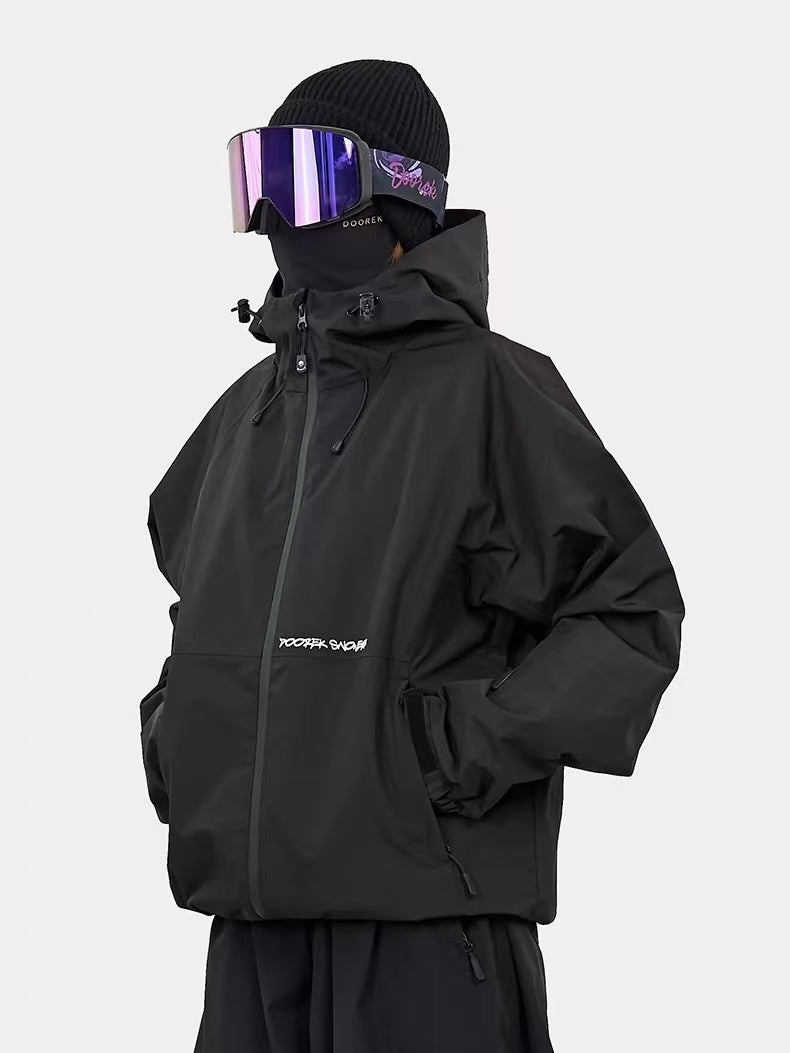
A hard shell is the roof of your layering system.
Shop the 20K Serpent Terrain 3-Layer Shell4 Myths About Ski Mid-Layers
Myth 1: Wool sweaters keep you warm even when wet, so they are still the best mid-layer.
Wet wool is warmer than wet cotton, but it is heavier, slower to dry, and harder to layer under a fitted shell than modern fleece or synthetic insulation. For active skiing, drying speed wins.
Myth 2: The thicker the mid-layer, the warmer you will be.
Thickness traps heat, but it also traps sweat. A thick fleece under a hard shell turns into a steam room on the uphill. Breathable, thin insulation with a good shell is warmer in practice because it stays dry.
Myth 3: Down cannot be used for skiing.
Modern DWR-treated down and hydrophobic down blends handle light moisture and dry quickly. In dry, cold resort conditions, a down vest is often the most efficient choice. Just avoid it in wet spring snow or heavy rain.
Myth 4: One heavy jacket is simpler than a three-layer system.
A heavy parka is simple until you overheat on the first run. Layering lets you add or remove insulation in increments. On a multi-day ski trip, it also means you can wash a base layer without losing your entire outfit.
Conclusion: The Invisible Layer Won
The wool sweater was not defeated by marketing. It was defeated by physics — by the realization that a skier's greatest enemy is not the cold air outside, but the moisture trapped inside. Fleece, synthetic insulation, and active insulation each solved a piece of that problem. Together, they turned the mid-layer from a single, visible garment into an invisible system of valves and buffers.
The irony is that wool is making a comeback, but not as your grandfather's sweater. Merino base layers and lightweight merino mid-layers now sit on the same rack as Polartec Alpha and PrimaLoft Gold. The fiber that started the story has returned as a supporting character — thinner, softer, and far more expensive than it was in 1930.
That is the real history of the ski mid-layer: not the death of wool, but the democratization of dryness. The skier who understands that history will spend less time shivering in the lodge and more time skiing in the storm.

Frequently Asked Questions
What is a ski mid-layer?
A ski mid-layer is the insulating layer worn between a base layer and an outer shell. Its job is to trap body heat while allowing moisture from sweat to escape. Common materials include fleece, synthetic insulation, down, and merino wool blends.
Is fleece or down better for skiing?
Fleece is more breathable and better for high-output skiing or wet conditions. Down offers a superior warmth-to-weight ratio and is ideal for cold, dry resort days. Many skiers own both and choose based on the forecast.
Should I wear a down vest as a mid-layer?
Yes, in cold, dry conditions. A down vest insulates the core — where heat loss is greatest — while leaving arms free for mobility. It also packs small for backcountry transitions. Avoid down vests in wet spring snow.
How many layers should I wear skiing?
Most skiers use three layers: a moisture-wicking base layer, an insulating mid-layer, and a weatherproof outer shell. In mild spring conditions, some skiers drop the mid-layer and wear only a base layer under a shell.
Does merino wool make a good mid-layer?
Lightweight merino works well as a mid-layer in mild to cool conditions. It regulates temperature across a wide range and resists odor better than synthetics. It does not dry as fast as polyester fleece, so it is less ideal for high-output ski touring.
Can I ski without a mid-layer?
On warm spring days or during intense aerobic touring, some experienced skiers wear only a base layer under a breathable shell. For most resort skiing in cold weather, skipping the mid-layer will leave you chilled on the lift and vulnerable if the weather changes.